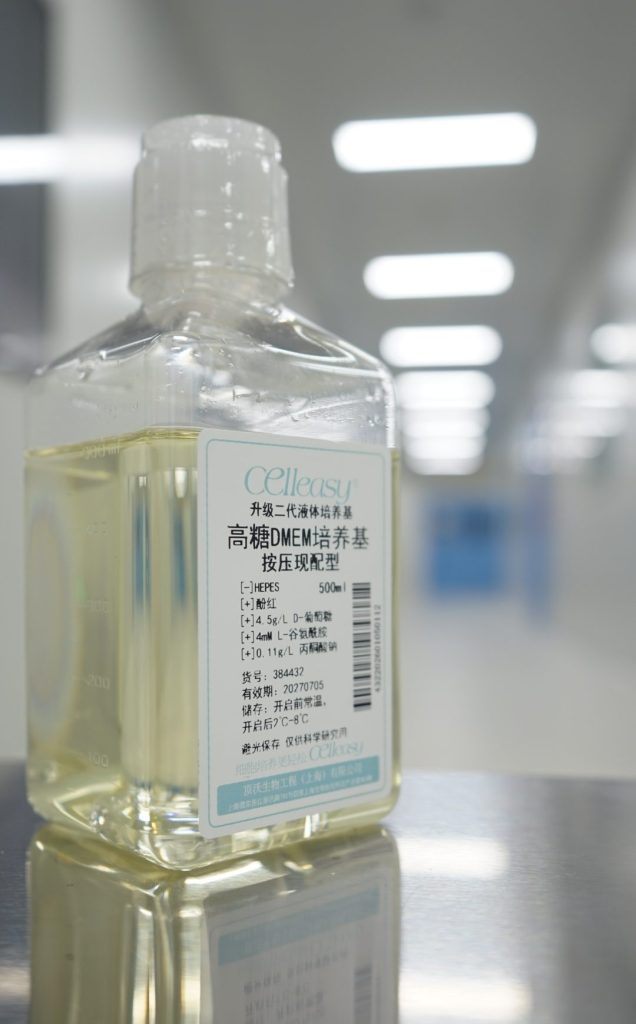

1. Innovative liquid form with dry-wet separation.
The second-generation culture medium adopts a dry-wet separation design, in which the easily degradable L-glutamine is stored as a dry powder in a compartment inside the bottle cap. Before use, simply press the cap to release the powder, then shake to dissolve. No filtration is required — truly achieving “press-to-mix” preparation. This greatly simplifies the operation procedure and reduces the risk of contamination.
2. Room temperature transport and storage, saving costs and space.
First-generation culture media typically rely on 4°C transport and storage, which not only incurs high logistics costs but also takes up valuable refrigerator space.The second-generation culture medium supports room temperature transport....and it can be stored at room temperature before use,requiring 4°C storage only after opening. This not only saves cold chain costs,but also significantly reduces refrigerator space,freeing up laboratory storage resources.
3. More stable core components, no additional supplementation required.
Glutamine is a key amino acid in cell culture, but it is extremely unstable in first-generation culture media,partially decomposed before use,leading to the need for additional supplementation for some cells. Through technological innovation,the second-generation culture medium ensures that glutamine remains almost completely undegraded before use,preserving the integrity of the formulation. Therefore,no additional supplementation is required,avoiding variations in experimental results caused by fluctuations in component composition.
4. No ammonia production, eliminating cytotoxicity.
First-generation culture media decompose and produce ammonia even during storage or before use.The generation of ammonia is toxic to cells and can easily lead to restricted growth or even death of sensitive cells.The second-generation culture medium addresses this issue by design,with no ammonia production before use,fundamentally eliminating the risk of ammonia cytotoxicity and providing a safer growth environment for various cells, especially sensitive ones.
5. Extended shelf life and stable quality.
First--generation culture media typically have a shelf life of 12 months.Through improved formulation and processes,the second-generation culture medium extends the shelf life to 18 months,ensuring stable quality throughout the entire product lifecycle.
6. Reliable results, supporting experimental success.
First-generation culture media carry potential risks of decomposition and deterioration, which can easily lead to poor cell growth or experimental failure. The second-generation culture medium,by ensuring stable quality and an equivalent experience to freshly prepared medium,not only promotes robust cell growthbut also helps researchers effectively avoid potential risks, significantly increasing the success rate of experiments.
Summary:
Choosing the second-generation culture mediummeans choosing convenience, stability, safety, and efficiency.Through technological innovation, it resolves many pain points of traditional culture media, safeguards cell growth, and is the better choice for pursuing high-quality experimental results.